Property management often gets framed as a lifestyle choice.
Something owners do when they’re too busy, too far away, or simply tired of dealing with tenants. That framing makes sense on the surface. It’s also incomplete.
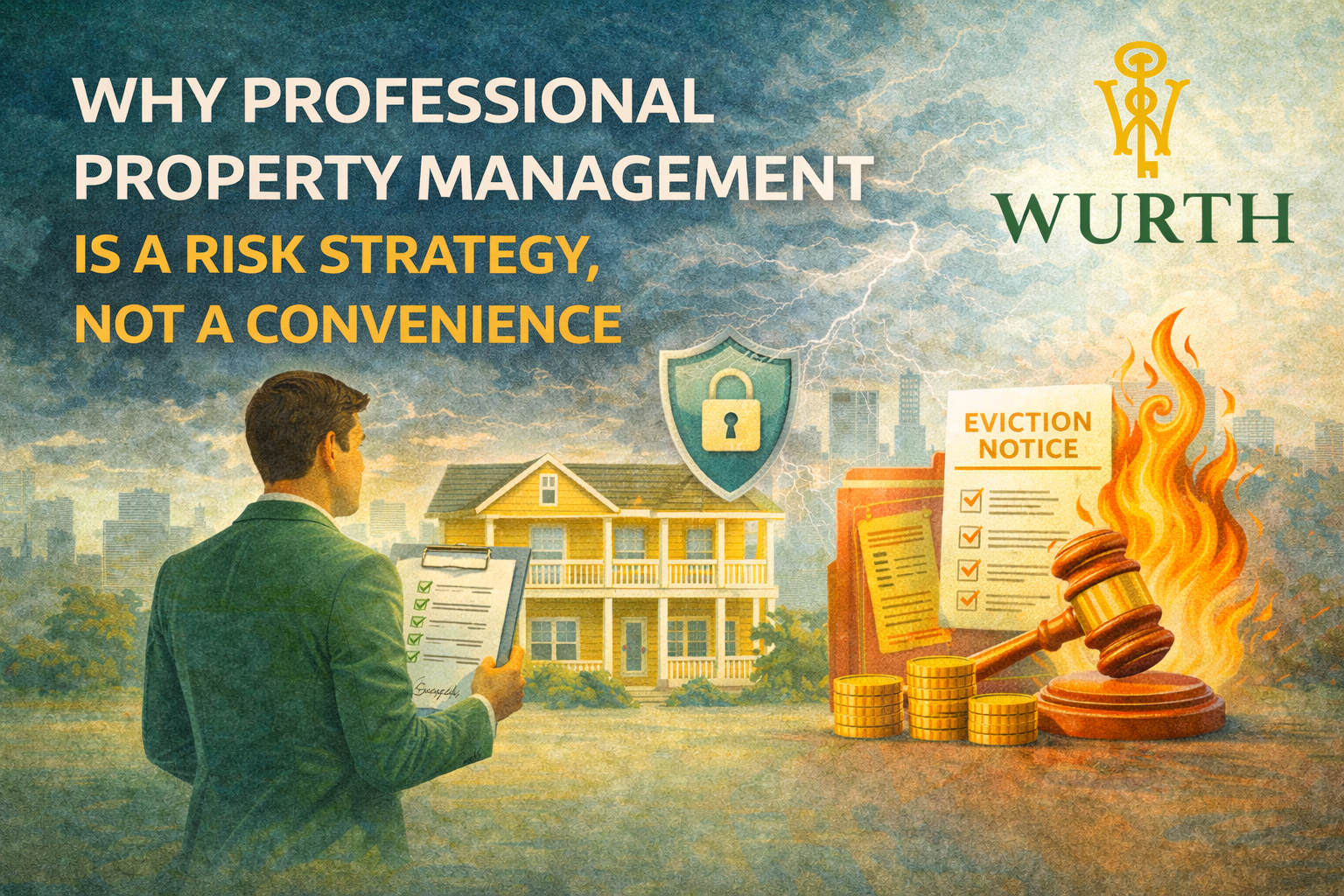
In reality, professional property management has increasingly become a way to manage risk. Not dramatic, headline-worthy risk. The quieter kind that builds slowly through small decisions, missed details, and inconsistent systems.
Most landlords don’t set out to take unnecessary risks. They accumulate them.
Risk in Rental Property Ownership Is Usually Invisible
The most expensive problems in rental ownership rarely announce themselves in advance.
They show up later. After a lease dispute escalates. After a maintenance issue becomes a habitability concern. After an eviction takes longer than expected. After a “good tenant” turns out to be anything but.
This is why rental property risk management has less to do with reacting well and more to do with preventing situations from forming in the first place.
Many owners assume that because nothing went wrong this year, the system is working. That assumption is understandable. It’s also risky.
Risk exposure often builds quietly in:
- Lease language that hasn’t been reviewed in years
- Screening criteria applied inconsistently
- Documentation gaps that don’t matter until they do
- Maintenance delays that slowly frustrate tenants
These issues tend to surface when conditions tighten, not when things feel calm.
Convenience Is a Side Effect, Not the Point
Professional property management does make ownership more convenient. That’s true.
But convenience is not the main benefit. It’s the byproduct of structure.
What actually reduces risk is consistency. The same screening process every time. The same documentation standards. The same response protocols. The same enforcement approach, regardless of tenant or situation.
When these systems are in place, fewer decisions are made emotionally or under pressure. That alone removes a significant amount of exposure.
Discussions around reducing legal exposure for landlords often come back to this idea. Risk decreases when fewer things are handled ad hoc.
Screening Is Where Risk Usually Starts
Most landlords understand tenant screening is important. Fewer understand how often it becomes inconsistent.
Standards drift. Exceptions get made. Urgency overrides process. A vacancy lingers, and suddenly a borderline application looks acceptable.
That’s rarely where problems start. Problems start months later, when payment issues arise or lease terms get challenged.
Content explaining how proper tenant screening reduces eviction risk tends to highlight this gap. Screening is not just about finding good tenants. It’s about reducing future decisions under stress.
Professional property managers typically treat screening as non-negotiable. That rigidity isn’t inflexibility. It’s protection.
Maintenance Is a Risk Factor, Not Just an Expense
Maintenance decisions are often treated as financial choices. Fix now or later. Upgrade or patch.
But maintenance also carries legal and operational risk. Deferred repairs can escalate into habitability issues. Slow responses can turn minor problems into tenant disputes.
Articles discussing how deferred maintenance quietly hurts ROI often focus on costs. The risk side is just as important.
When maintenance is handled reactively, response times stretch. Documentation becomes scattered. Communication gets inconsistent. Each of those increases exposure.
Preventive maintenance planning, by contrast, reduces urgency-driven decisions. It also reduces the likelihood of disputes that stem from frustration rather than actual damage.
This is one reason professional property management tends to stabilize operations over time.
Evictions Are Rarely the First Failure
Evictions feel like the problem. They usually aren’t.
They’re the result of earlier breakdowns. Screening. Communication. Enforcement. Documentation. One or more of these typically failed long before legal action became necessary.
Content around patterns that lead to avoidable evictions often points out that eviction rates reflect systems, not tenants alone.
Lower eviction rates don’t happen because tenants behave better. They happen because expectations are clearer and consistently enforced.
This is where experienced property managers quietly reduce risk. Not by avoiding enforcement, but by applying it evenly.
Turnover Increases Exposure in Subtle Ways
High turnover doesn’t just affect cash flow. It increases risk.
More move-outs mean more leases. More screenings. More inspections. More opportunities for mistakes. Even well-run owners feel the strain when volume increases.
Discussions about the hidden costs of frequent vacancies often focus on lost rent. The operational exposure is less visible but just as real.
Retention reduces repetition. Repetition is where errors creep in.
This is why strategies aimed at reducing unnecessary tenant turnover tend to support risk management indirectly. Fewer transitions mean fewer decision points.
Self-Managing Works Until It Doesn’t

Many landlords self-manage successfully for years.
That doesn’t mean the approach is risk-free. It means the risk hasn’t surfaced yet.
As portfolios grow, regulations change, or markets tighten, the margin for error narrows. What once felt manageable begins to feel fragile.
This is often when owners start reassessing their setup, not because they want less involvement, but because they want more predictability.
Professional property management, in this context, becomes less about delegation and more about durability.
Risk Management Is Boring by Design
Good risk management doesn’t feel exciting.
It feels repetitive. Documented. Slightly rigid. Uneventful. Those qualities are the point.
When systems work, nothing dramatic happens. Tenants renew. Repairs get handled. Notices get sent correctly. Disputes stay small.
This is why property management as a risk strategy often gets overlooked. It doesn’t announce itself. It simply reduces volatility.
Looking Ahead With Fewer Unknowns
As rental markets move into 2026, uncertainty is not disappearing. Insurance costs. Climate exposure. Tenant expectations. Regulatory shifts. None of these are static.
Managing risk in that environment requires structure more than speed.
For owners who want fewer surprises, working with experienced property managers can provide that structure. At Wurth Property Management, we work with landlords across the Gulf South to reduce exposure through consistent systems and proactive oversight. If property management has felt like a convenience in the past, it may be worth reconsidering it as something more strategic going forward.
FAQs
1. Is property management mainly about convenience?
A: Convenience is a benefit, but the primary value is reducing operational and legal risk.
2. How does property management reduce risk for landlords?
A: Through consistent screening, documentation, maintenance planning, and enforcement.
3. Does self-managing increase risk?
A: Not always, but risk increases as complexity, volume, or regulations change.
4. Why is tenant retention part of risk management?
A: Lower turnover reduces repetition, errors, and exposure across operations.
5. When should landlords consider professional management?
A: When predictability, compliance, and long-term stability matter more than short-term control.